All-in-one, or asset allocation Exchange Traded Funds (ETFs), have quickly become one of the most popular investment choices for Canadians. As of December 31, 2025, Canadians have invested more than $40 billion into these funds across RRSPs, TFSAs, RESPs, and nonregistered accounts.¹
Why are these investments so popular? Investors are drawn to several key features: simplicity, broad diversification, liquidity, and low fees. Let’s explore what exactly an asset allocation ETF is, and the benefits it holds.
What Is an Asset Allocation ETF?
An asset allocation ETF is a single ETF that provides global market exposure by holding several underlying ETFs which are invested in different areas of the market. Each ETF maintains a preset mix of equities and fixed income, allowing investors to choose the risk level that best suits their goals right from the start.
The appeal is simple: with one trade, you gain exposure to multiple regions and asset classes, typically including U.S., Canadian, international, and emerging market equities, along with Canadian and U.S. bonds.
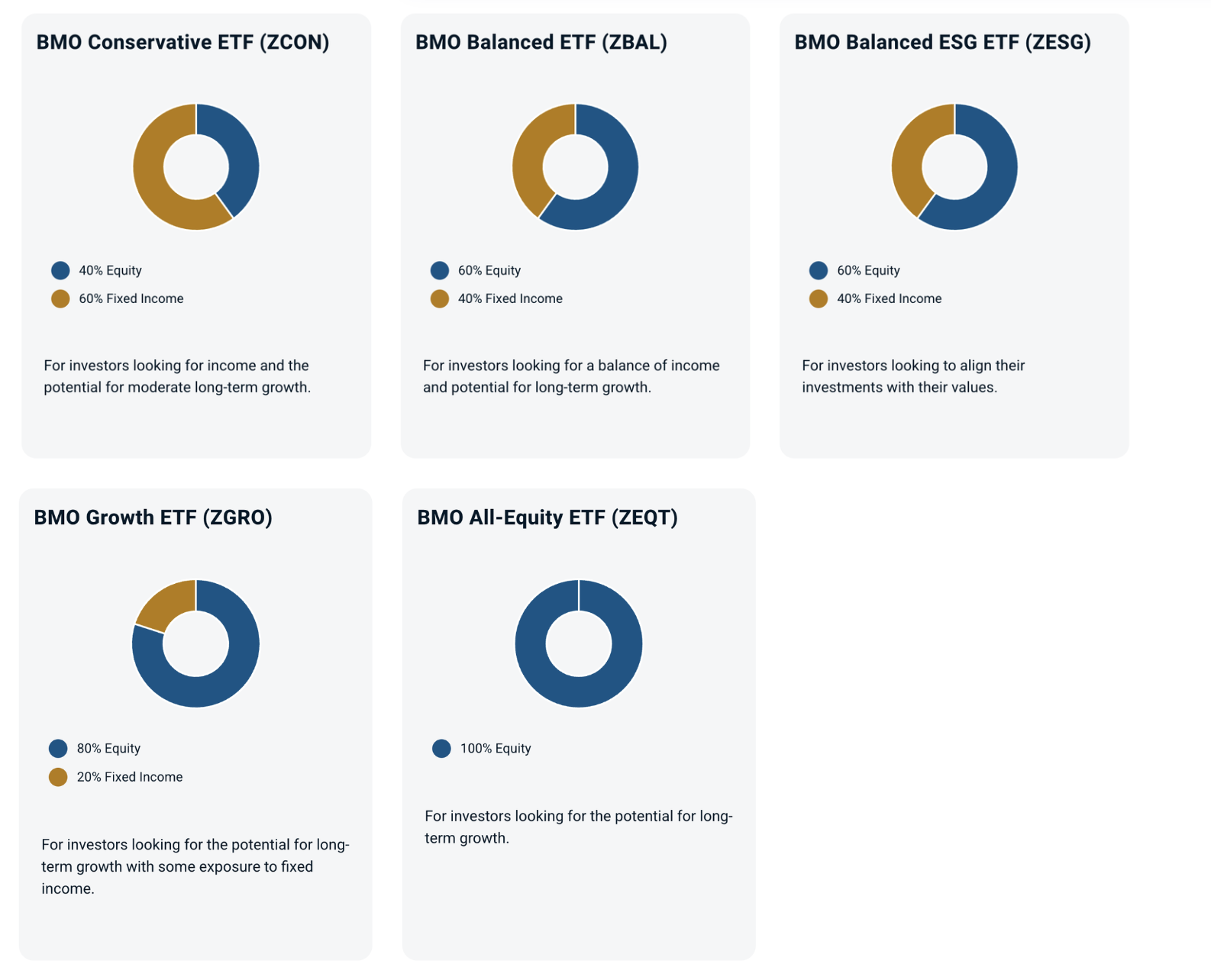
These ETFs come in various equity–fixed income combinations, allowing investors to match their risk profile. For example, for growth-focused investors seeking full equity exposure, an option like BMO’s All-Equity ETF (ZEQT) which contains 100% equity exposure may be appropriate. For investors who prefer more stability, a balanced option such as BMO’s Balanced ETF (ZBAL)—with 60% equities and 40% fixed income—may be a better fit.
Source: BMO ETFs, January 2026.
Easy to Use
Asset allocation ETFs are a top choice for “set-it-and-forget-it” investors. With just one purchase, you can implement a fully diversified global portfolio. These funds require very little monitoring because the equity and fixed income weights are automatically rebalanced to maintain your chosen risk level.
Rebalancing is especially important during rising markets, where equities can gradually dominate your portfolio and increase risk beyond what you intended. These ETFs also rebalance country and sector exposures, ensuring no single area becomes disproportionately over weighted over time.
Diversification: The Only Free Lunch in Investing
Diversification remains one of the most effective ways to manage risk. Many investors often focus on potential returns without fully understanding the amount of risk required to achieve them. While risk profile varies by person, investors with longer time horizons generally have the ability to take on more risk while investors with shorter time horizons may require more stability in their portfolios.
Popular investment fads—such as cryptocurrency, AI-focused stocks, or gold funds—often concentrate exposure in a single sector, theme, or commodity. This can significantly increase risk, especially in speculative or volatile markets.
In contrast, asset allocation ETFs spread exposure across thousands of stocks and bonds globally, representing virtually all major countries and sectors. This wide diversification lowers risk because the likelihood of a severe decline across thousands of securities simultaneously is far lower than the risk associated with holding only one or two concentrated positions.
Due to this built-in diversification, many investors find they don’t need to hold additional funds or individual stocks in their portfolios.
Liquidity
Liquidity refers to how quickly an investment can be converted into cash. Some investments such as real estate, certain GICs, or private market funds are far less liquid.
Asset allocation ETFs, however, trade on major stock exchanges and can be bought or sold at any time during market hours (Monday through Friday). Once sold, the cash typically appears in the investor’s account immediately. Trading commissions vary by brokerage, but many platforms now offer these trades at very low cost, or even no commission at all.
For investors who may need access to their money quickly, such as someone preparing for a home purchase, this liquidity is a key advantage.
Low Fees
Another compelling benefit is their low cost. Most Canadian asset allocation ETFs charge a Management Expense Ratio (MER) between 17 and 25 basis points (0.17%–0.25%), well below the Canadian ETF industry average MER of 0.67%.²
Historically, many investment funds in Canada charged 1–2% in fees, though these costs have been trending lower in recent years, thanks in large part to ETFs.
Since fees directly reduce investment returns, especially when compounded over many years, choosing a lower-cost option can help investors reach their financial goals sooner by keeping more of their returns working for them.
How Do I Choose an Asset Allocation ETF?
Before investing in any fund, it’s important to understand your investment goals, time horizon, objectives, and risk profile. This will help you determine whether an asset allocation ETF is appropriate—and which equity/fixed income mix makes the most sense.
While these ETFs are extremely simple to use, choosing among them can be more complex. There are now more than 90 all-in-one ETFs available in Canada from a variety of providers.³ When evaluating your options, consider:
- Reputation of the asset manager: Do they have a long history and strong operational stability?
- Track record: Longer performance histories offer insight into how the fund has navigated different market environments.
- Underlying ETFs: Some funds use broad-market index ETFs, while others use active strategies.
- Fees: While many Asset Allocation ETFs are low cost, not all are, so review the MER carefully.
Conclusion
Asset allocation ETFs have earned their place as a go-to investment solution for Canadians by offering a powerful combination of simplicity, diversification, liquidity, and low costs. With one trade, investors can access a professionally constructed global portfolio while benefiting from automatic rebalancing and a disciplined approach to managing risk.
Whether you’re a new investor looking for an easy starting point or a seasoned investor seeking a low-maintenance core holding, all-in-one ETFs provide an efficient, transparent way to stay invested and on track with your long-term financial goals. As always, the right choice comes down to understanding your needs, your time horizon, and your comfort with risk—but for many investors, these ETFs offer a straightforward path toward building lasting wealth.
Learn more about BMO’s Asset Allocation ETFs
Sources
- National Bank ETF Report, December 2025.
- BMO Asset Management, November 30, 2025.
- National Bank ETF Report, December 2025.
Notes
One's risk profile is comprised of risk tolerance (i.e., willingness to accept risk) and risk capacity (i.e., ability to endure potential financial loss). Management Expense Ratios (MERs) are the audited MERs as of the fund’s fiscal year end. MER might not be displayed if the fund is less than one year old since the audited MER of the fund has not gone through a financial reporting period.
Disclaimer
This material is for information purposes only. The information contained herein is not, and should not be construed as, investment, tax or legal advice to any party. Particular investments and/or trading strategies should be evaluated relative to the individual’s investment objectives and professional advice should be obtained with respect to any circumstance. Commissions, management fees and expenses all may be associated with investments in exchange traded funds. Please read the ETF Facts or prospectus of the BMO ETFs before investing. Exchange traded funds are not guaranteed, their values change frequently and past performance may not be repeated. For a summary of the risks of an investment in the BMO ETFs, please see the specific risks set out in the BMO ETF’s prospectus. BMO ETFs trade like stocks, fluctuate in market value and may trade at a discount to their net asset value, which may increase the risk of loss. Distributions are not guaranteed and are subject to change and/or elimination. BMO ETFs are managed by BMO Asset Management Inc., which is an investment fund manager, portfolio manager, and a separate legal entity from Bank of Montreal. “BMO (M-bar roundel symbol)” is a registered trademark of Bank of Montreal, used under licence.
Best next step
Keep exploring this topic
If you want to go deeper, these are the most useful follow-up pages and tools for this topic.
Gold ETFs
Best gold ETFs in Canada
Compare physically backed and miner gold ETFs, including CGL, VALT, KILO, and XGD.
ETF hub
Browse ETF categories by goal
Jump into core, dividend, fixed-income, and sector ETF clusters from one place.
ETF tool
Use the Canadian ETF screener
Filter ETFs by yield, AUM, and performance when you are narrowing a shortlist.
Popular guide
Start with our top ETF roundup
Start with a broad ETF guide if you want a quick shortlist across the main fund categories.
✅ Reviewed by Certified Financial Professionals
This content has been reviewed by CFA® charterholders and Certified Financial Planners (CFP®) with over a decade of experience in Canadian financial markets. All information is fact-checked against official Canadian sources and regulations.
Why these credentials matter: CFA® charterholders complete 900+ hours of rigorous study in investment analysis and ethics. CFP® professionals are held to the highest standards of financial planning competency and fiduciary duty in Canada.
⚠️ Professional Disclaimer
This content is for educational purposes only and should not be considered personalized financial advice. While our team brings professional expertise, individual circumstances vary. For personalized guidance, consult with a qualified financial advisor, tax professional, or mortgage specialist.