
Earn up to $5,000 in cashback
+$100 quick-pay bonus when you open and fund a new Qtrade account. Promo code OFFER2026.
- ✓September 1, 2026 – January 5, 2027
- ✓$0 commission on stocks, ETFs, and mutual funds
- ✓Up to $150 transfer-fee rebate per $15,000+ transfer
Back in 2008, the Qtrade vs Questrade rivalry was already in full swing, with each platform attracting a loyal following. Fast forward sixteen years, and both have widened the gap between themselves and Canada’s big bank brokerages, solidifying their positions as top contenders for DIY investors.
As a long-time personal finance writer, I’ve opened over a dozen brokerage accounts in the past two decades. I’ve also fielded countless questions and comments on brokers from readers. When updating my brokerage comparison articles, I often collaborate with our staff writers (many of whom are also DIY investors) to ensure we’re sharing the most up-to-date insights.
For me, the qtrade vs questrade debate boils down to a few key points:
Advertisement
-
Qtrade’s Superior Rankings: Qtrade consistently ranks higher in third-party reviews from reputable sources like The Globe and Mail, Surviscor, and MoneySense. Their strong performance across multiple rankings makes them a standout in the industry.
-
Top-notch Customer Service: Qtrade offers the best customer service in Canada right now. For retail investors, especially those new to investing, having quick and reliable support is a huge advantage.
-
Free ETF Trading: While both platforms offer free ETF purchases, Qtrade also allows you to sell ETFs for free, whereas Questrade charges a fee when selling ETFs. This added benefit makes Qtrade more appealing for ETF-focused investors.
-
Better Signup Bonuses: Currently, Qtrade’s promotion of up to $5,000 in cashback (+$100 quick-pay bonus) outshines Questrade’s offer of $50 in free trades. For new investors, that extra cash can make a big difference when starting out.
Ultimately, both platforms are strong choices, but if I had to pick one today, Qtrade’s superior customer service, free ETF trading (both buying and selling), and better bonuses give it the edge over Questrade.
Qtrade vs Questrade Quick Comparison
If you're seeking a quick comparison between Questrade and Qtrade, check out the visual chart below. It highlights the key areas from our comprehensive broker reviews, giving you a clear overview of how these two popular platforms stack up in the most important categories.
| QTRADE | QUESTRADE |
|---|---|
| Free ETFs | Yes! free buying AND selling of 100+ ETFs. |
| User Experience | Consistently ranking #1, high availability and friendly to customers |
| Customer Service | Truly elite customer service, basically, the #1 reason to go with Qtrade |
| Trading Fees | Very competitive, $6.95/trade for Investor Plus Program members, $7.75 for investors aged 18-30, $8.75 for everyone else |
| ECN Fees (additional trading fees) | None whatsoever |
| Account Fees | $25 per quarter - WAIVED IF you hold $25,000 in the account OR you make 2 trades per quarter or 8 in the last 12 months OR you add $100+ automatic recurring monthly contribution (our preferred option) |
| Transfer Fees | Free Electronic Funds Transfer. Additional fee for transferring out. |
| Research Tools and Education Materials | Has been at the top of Canadian brokerage rankings in this category for over a decade |
| Safety | CIPF Member |
| Mutual Fund Purchases | Fees Apply |
| Promo | New clients only: Earn up to $5,000 in cashback (+$100 quick-pay bonus) |
| Full Review | Qtrade Review |
Brokerage Investing Account Options
When WealthAwesome first began comparing online brokerages, there were noticeable gaps between the “haves” and “have nots” in terms of account offerings. Fortunately, with growing competition, most brokers now provide a comprehensive range of Canadian investment account options.
When we look specifically at Qtrade and Questrade, the differences in account options are minimal. Both brokerages offer the most common accounts Canadians need: RRSP, TFSA, RESP, non-registered trading accounts, margin trading accounts, and joint investment accounts.
Beyond these, both Qtrade and Questrade also provide access to more specialized accounts, including USD accounts, spousal RRSPs, options trading, and corporate trading accounts. Essentially, they offer almost every account type you’d expect from a major broker. Unfortunately, the RDSP (Registered Disability Savings Plan) remains an overlooked option in the world of Canadian personal finance.
February 2024 Update: Both Qtrade and Questrade were early adopters in offering the new FHSA (First Home Savings Account). The primary difference between the two is that Qtrade currently has a limited-time promotion where you can get hundreds of dollars in instant cashback when you open an FHSA. Aside from that, their FHSA accounts are nearly identical.
To open an FHSA, you’ll need a minimum deposit of $250, and you can contribute up to $8,000 per year, with a lifetime maximum of $40,000.
Customer Service Comparison
While Questrade has long been a leader in per-trade fees in Canada, the surge in DIY investing, coupled with the logistical challenges brought on by COVID-19, led to significant customer frustration throughout 2020 and 2021. Reports of 3-5 hour wait times—whether via phone or online messaging—became common, putting a spotlight on the importance of reliable customer service.
That’s not to say that Questrade won’t adapt to the changing landscape in 2024, but the demand for strong customer support has propelled Qtrade to the top of the discount brokerage rankings.
Questrade has acknowledged these challenges and has made efforts to improve their customer service by increasing manpower. However, time will tell if these efforts lead to long-term improvements.
For experienced investors who rarely need customer support, Questrade’s consistently low fees may still make it the best fit. However, if customer service is a priority, Qtrade has made a clear commitment to providing an excellent user experience.
Qtrade has invested heavily in hiring top-notch customer service professionals and maintaining high standards, earning praise from industry experts.
here are some industry expers view on qtrade vs questrade
-
“Qtrade excels in every area – especially in customer service.”
– Mark Brown, Investing and Rankings Editor for MoneySense -
“We congratulate Qtrade Investor for its convincing win… and for its commitment to innovation and unmatched service levels.”
– Glenn LaCoste, President of Surviscor
Rob Carrick from the Globe and Mail has also consistently awarded Qtrade top marks for several years.
Ultimately, Qtrade’s 15 years of experience in leading online broker customer service sets it apart as the long-term brokerage solution you can trust to stay ahead of the curve.
— Frugal Trader, MillionDollarJourney Founder
Questrade vs Qtrade ETFs
I’m happy to report that both Questrade and Qtrade have significantly prioritized their ETF trading strategies, putting them leagues ahead of Canada’s big banks. Here’s how they stack up:
Qtrade: Qtrade allows you to both buy AND sell ETFs for free on a selection of over 100 ETFs. While not every ETF is covered, index investors (especially Couch Potato investors) will find plenty of options to meet their needs. Some of my favorites include:
-
Horizons S&P/TSX 60 Index ETF (HXT)
-
Horizons S&P 500 Index ETF (HXS)
-
iShares MSCI Emerging Markets Index ETF (XEM)
-
iShares Global Real Estate Index ETF (CGR)
-
iShares Canadian Government Bond Index ETF (XGB)
-
iShares Core Growth ETF Portfolio (XGRO)
-
iShares Core Equity ETF Portfolio (XEQT)
If you're focused on keeping fees as low as possible, opening an account with Qtrade and using these ETFs for rebalancing is completely free. It’s hard to beat that!
Questrade: Questrade, on the other hand, allows you to buy ETFs for free, but you’ll have to pay their regular trading fees when you sell them. This means that every time you rebalance your portfolio, you’ll incur a cost when selling ETFs. While free ETF purchases are still a great deal, Qtrade’s ability to offer both free buys and sells gives it a clear edge.
The Bottom Line: When it comes to ETF trading, Qtrade is the better option, offering true fee-free ETF trading for both purchases and sales, which can make a big difference in long-term portfolio management.
Qtrade Investor vs Questrade Fees and Commissions
There’s no question that Questrade stands out when it comes to offering low fees and commissions. Over the years, they’ve built a strong reputation around this, with a basic trading fee of just $4.95 for up to 500 shares and a maximum of $9.95 per trade, making it a great value for Canadian investors.
That said, Qtrade isn’t far behind with its standard trading fee of $8.75 per trade, which drops to $6.95 for frequent traders. While slightly higher than Questrade, Qtrade’s fees still come in below those charged by Canada’s big banks like RBC, TD, BMO, and Scotiabank.
Both platforms offer solid value, but Questrade takes the lead in terms of cost-efficiency for everyday traders.
Here’s a few other fee comparison points in the Qtrade vs Questrade battle:
When comparing Qtrade and Questrade, there are several key fee structures to keep in mind. Let’s break them down:
ECN Fees:
ECN fees are small amounts added to your base trading fee. Qtrade stands out by not charging ECN fees at all, whereas Questrade applies them when a trade "removes equity from the market." For most investors, this fee is relatively small, but it’s something to be aware of when using Questrade.
Account Fees:
Qtrade charges a $25 quarterly account fee, but don’t worry – there are easy ways to have it waived (we’ll outline those steps below). On the other hand, Questrade has no inactivity fees, which makes it ideal for more passive investors.
ETF Trading:
When it comes to ETFs, Qtrade has the upper hand. Their commission-free ETFs are both free to buy and sell with no minimums. In contrast, Questrade offers free ETF purchases, but you’ll have to pay a fee when you sell.
Dividend Reinvestment Plan (DRIP) Fees:
Both Qtrade and Questrade offer free Canadian and American DRIPs, allowing you to automatically reinvest your dividends without any extra cost.
Forex Spread Fees:
Questrade charges a 5% forex spread fee for converting between Canadian and U.S. dollars. This fee can add up if you're regularly trading in different currencies, so keep that in mind if you’re dealing with both CAD and USD investments.
Transfer Fees:
Both platforms will reimburse you up to $150 when transferring your broker account from another provider, which is great if you’re looking to make the switch.
In summary, both platforms have their pros and cons when it comes to fees, but for investors focused on ETFs and avoiding extra fees like ECN charges, Qtrade might be the better fit. However, for those prioritizing lower trading costs and no inactivity fees, Questrade still holds its ground.
Avoiding the Qtrade Account Fees
To get the most out of Qtrade and avoid unnecessary fees, it's crucial to understand how to sidestep their quarterly account fees. These fees can add up quickly, especially for smaller accounts, but Qtrade makes it easy to avoid them by following a few simple steps.
Here’s how to waive Qtrade’s quarterly account fees:
-
Set up an automated contribution – This is my top recommendation for new investors. By setting up a recurring electronic funds transfer of $100 or more from your bank account to your Qtrade brokerage account each month, you can bypass the quarterly fees. Plus, this regular contribution is a great way to build good investing habits from the start.
-
Maintain a minimum balance – If you have at least $25,000 in assets in your account on the last business day of the quarter (which are every 3 months in the investing world), Qtrade will automatically waive the fee.
-
Make two trades per quarter – Complete two commission-generating trades during the preceding quarter, and you won’t have to worry about the fee.
-
Execute 8 trades in a year – If you prefer a less frequent trading schedule, completing 8 or more trades over the last 12 months will also waive the fee.
-
Young Investor Program – If you’re between the ages of 18 and 30, Qtrade offers the Young Investor plan, which allows you to avoid the fees as long as you set up a $50 pre-authorized contribution (PAC).
By following one of these strategies, you can keep your account growing without getting hit with unnecessary fees, making Qtrade an even better option for both new and seasoned investors.
Qtrade vs Questrade Fees Bottom Line
When it comes to choosing the best online broker in Canada, it really depends on your investing style and what your portfolio looks like.
If your portfolio consists primarily of Canadian ETFs, then Qtrade is the top choice. It offers free ETF buying and selling, making it incredibly cost-effective for ETF-focused investors, especially those following the popular Couch Potato strategy.
However, if your portfolio includes a wider range of assets like individual stocks, international investments, or a mix of ETFs and other securities, Questrade might be the better option. As the cheapest broker overall, Questrade’s low trading fees for non-ETF transactions, combined with free ETF purchases (though you'll need to pay to sell), make it a strong contender for those with more diverse portfolios.
Ultimately, Qtrade shines for Canadian ETF investors, while Questrade offers the lowest costs for everyone else. The key is matching the broker to your investing strategy to maximize savings.
Are Qtrade and Questrade Safe?
Both Qtrade and Questrade are extremely safe to use, offering top-tier security that rivals Canada’s largest banks, including TD, RBC, BMO, CIBC, and Scotiabank. When it comes to cybersecurity, both brokers prioritize the protection of your investments through advanced digital security features like encryption, two-factor authentication, and 24/7 monitoring.
What truly sets them apart in terms of security is their membership in the Canadian Investor Protection Fund (CIPF). This government-backed initiative ensures that your investments are protected up to $1 million CAD per account type in the rare event of institutional risks like bankruptcy or fraud. For example, you’re covered up to $1 million for your RRSP, another $1 million for your joint account, and additional amounts for your TFSA, RESP, and so on.
However, it’s important to remember that while this safety net protects your funds from institutional risks, it does not shield you from market volatility. If your investments take a hit due to market fluctuations, that risk remains yours to bear. The protection offered by Qtrade and Questrade is about the security and safeguarding of your held assets—not a guarantee against potential investment losses.
In short, both Qtrade and Questrade offer the highest level of security for your investments, giving you peace of mind while you focus on your long-term financial goals.
Comparing Questrade and Qtrade Desktop and Mobile App Platforms
Both Qtrade and Questrade have developed and refined exceptional desktop and mobile app platforms, making it easy for investors to manage their portfolios on the go. However, when comparing user feedback, Qtrade's app stands out with higher ratings in both the Apple App Store and Google Play Store.
This suggests that Qtrade has managed to create a more user-friendly experience overall, with a smoother interface and better performance, making it a top choice for those who value seamless mobile trading and account management. While both platforms offer great functionality, Qtrade edges out Questrade in terms of customer satisfaction on mobile.
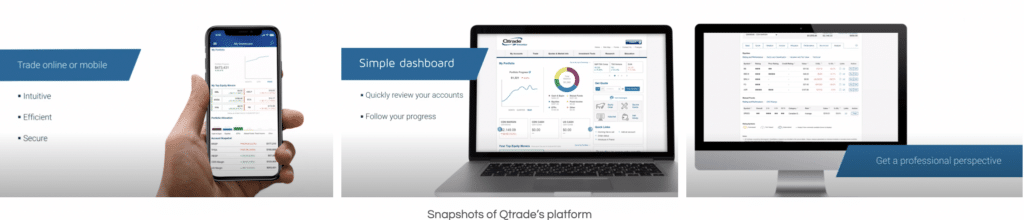
When it comes to their newest desktop platforms, you really can’t go wrong with either Qtrade or Questrade. Both offer excellent user experiences, which is why I personally stick to their desktop platforms and tend to avoid mobile investing apps.
That said, if you’re just starting out or prefer a more intuitive interface, I’d say Qtrade is slightly more beginner-friendly. Its clean layout and easy navigation make it ideal for new investors who want a straightforward experience, while still offering the advanced features that more experienced traders need.
Globe and Mail Qtrade vs. Questrade Comparison
We were pleased to see that Rob Carrick over at The Globe and Mail echoed our thoughts on the Qtrade vs. Questradedebate. In his 2022 broker comparison, Qtrade came out on top with the highest rating, while Questrade followed closely with a solid B+.
Here’s what Carrick had to say in his review:
"Qtrade continues to excel across the board, offering an impressive mix of features, intuitive user experience, and top-notch customer service. It remains a top choice for both beginner and experienced investors. Questrade isn’t far behind, providing competitive fees and solid features, but its customer service lags slightly compared to Qtrade."
It’s always great when expert analysis aligns with our own, and in this case, it further solidifies Qtrade as the best overall option for most Canadian investors, with Questrade being a strong runner-up.
Surviscor 2023 Rankings: Qtrade vs Questrade
Every January for the past two decades, Surviscor has released its highly anticipated rankings on the service experience offered by Canadian brokers. These rankings are based on an extensive analysis, collecting over 100,000 data pointsacross various metrics. Surviscor evaluates user experience on both desktop and mobile platforms, while also considering customer service quality and investor education efforts. This comprehensive review provides valuable insight into which brokers are truly delivering the best experience for Canadian investors.
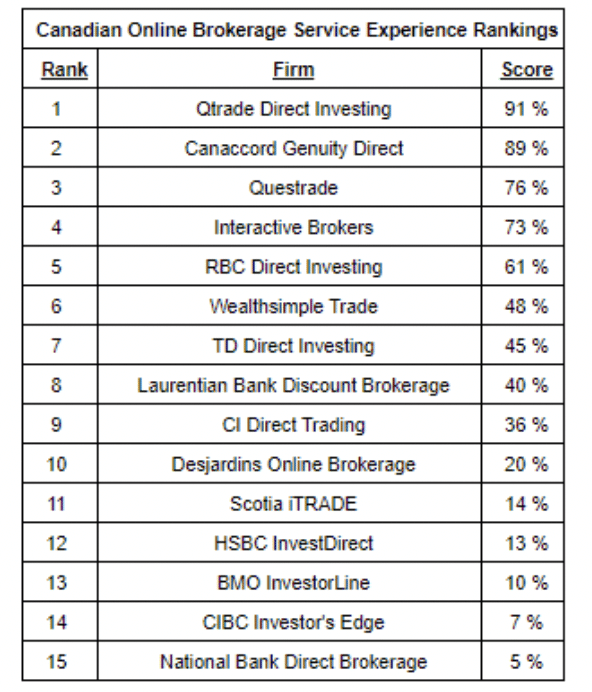
As you can see from the 2023 rankings, Qtrade dominated the field. The only online brokerage that came close was the niche firm CGD, which isn’t widely available across the country.
Questrade still secured an impressive third place, with Surviscor praising its much-improved customer response times, chat services, and the beginner-friendly design of its mobile app. However, Surviscor noted that there is still room for improvement, particularly in the areas of ETF fees, overall service experience, and ECN fees.
Glenn LaCoste, President of Surviscor Group, praised Qtrade, stating, “Congratulations to Qtrade Direct Investing for its continued service response excellence and its breadth of service interaction choices for all types of digital investors.”
Christine Zalzal, Head of Online Brokerage and Digital Wealth at Qtrade, echoed this sentiment, commenting, “What makes a great online brokerage firm for investors is not only a great online trading experience but also being supported by a great service team. At Qtrade, we’re always listening to our customers. A strong customer-focused culture is embedded in our DNA. As more Canadians explore self-directed investing, we’re continuing to invest in our people and platform to help them confidently build their wealth.”
These findings align with my own experiences using both platforms, as well as the feedback from our editorial team. The data supports what we’ve consistently seen: Qtrade excels in providing a well-rounded, customer-first approach, while Questrade continues to improve in key areas.
Questrade vs. Qtrade: Frequently Asked Questions
1. Which brokerage offers lower fees: Questrade or Qtrade?
Both Questrade and Qtrade have competitive fee structures. Questrade charges $4.95 to $9.95 per trade, and they don’t charge for buying ETFs (though you’ll pay to sell them). Qtrade charges $8.75 per trade but offers free ETF buys and sells on a select list of ETFs, making Qtrade potentially more cost-effective for ETF investors.
2. What are the major differences in customer service between Questrade and Qtrade?
Qtrade consistently ranks higher for customer service compared to Questrade. In 2024, Qtrade received top marks from Surviscor and other third-party reviewers for their excellent response times and customer service options, while Questrade has worked to improve its service but still trails slightly behind.
3. Which platform is better for beginner investors?
Qtrade is considered more beginner-friendly due to its easy-to-navigate platform and exceptional customer service. Questrade, while still accessible, is better suited for more experienced investors who prioritize low fees over support.
4. is Qtrade better than questrade?
Qtrade and Questrade are both strong Canadian online brokerages, but they excel in different areas. Qtrade is praised for its user-friendly interface, detailed research tools, and low account minimum (no minimum to start). Meanwhile, Questrade offers lower trading fees, free ETF purchases, and more advanced features for active traders.
5. Are there account fees at Questrade or Qtrade?
Questrade has no inactivity or account fees, while Qtrade charges a $25 quarterly fee unless you meet specific criteria (such as maintaining a balance of $25,000 or more, making recurring deposits, or executing a certain number of trades). You can avoid these fees easily by following the outlined steps.
6. Which broker has better research tools and educational resources?
Both Questrade and Qtrade provide strong research tools, but Qtrade edges ahead due to its integration of resources like Morningstar and more investor education content. This makes it a better choice for investors who want more educational support.
7. 7. Are my investments safe with Questrade and Qtrade?
Yes, both Questrade and Qtrade are safe and secure for Canadian investors. Both platforms are members of the Canadian Investor Protection Fund (CIPF), which protects deposits up to $1 million per account type. Additionally, both brokerages use advanced cybersecurity measures to ensure the safety of their platforms.
These FAQs should provide a clear overview of the key differences and considerations between Questrade and Qtrade in 2024.
Comparing the Qtrade vs Questrade Promo Offers
As we kick off 2024, the Questrade vs. Qtrade debate remains a key decision for Canadian DIY investors. In their ongoing competition to attract investors, Qtrade has unveiled one of the most attractive promo offers I’ve ever seen—surpassing even last year’s impressive deal.
This year, Qtrade is offering up to $5,000 in cashback to investors who open a qualifying account and open and fund a new Qtrade account during the campaign period (September 1, 2026 – January 5, 2027).
Here’s a breakdown of how much cash you can score just by signing up and using Qtrade’s platform:
(Insert breakdown of cash-back tiers based on deposit amounts here)
Whether you're new to investing or already have an account elsewhere, this cash-back offer is a fantastic incentive to check out what Qtrade has to offer in 2024. With their strong customer service, beginner-friendly platform, and this generous promotion, Qtrade continues to make a compelling case for being Canada’s top online broker.
| New Funds / Assets Transferred | Cashback Bonus |
|---|---|
| $1,000 – $4,999 | $0 (only $100 sign up bonus) |
| $5,000 – $24,999 | $250 Cash Back + $100 |
| $25,000+ | 1% Cash Back, Capped at $2,000 |
Here are some other key details about this incredible offer from Qtrade:
-
Just starting out? No worries. Qtrade will still give you a $100 bonus if you open an account and deposit $1,000.
-
There’s an additional $50 bonus if you open a First Home Savings Account (FHSA) with Qtrade.
-
Your total assets across all new Qtrade accounts qualify. This means that if you transfer over your TFSA and RRSP from another brokerage, plus start a new RESP or FHSA with Qtrade, you can combine all of those assets to meet the funding thresholds for the cash-back offer mentioned above.
Now, let's compare that to Questrade. Currently, Questrade is offering a unique promo code that gives you $50 in free trades when you open a new account. While that’s better than most other Canadian brokerages, it just doesn’t stack up against Qtrade’s generous cash-back offer.
Questrade’s commercials may be entertaining, but Qtrade’s approach of putting real money back into the pockets of new customers is even more appealing!
We’ve seen Qtrade run this promo before, and no other brokerage has come close to matching it. If you want to take advantage of this Early Bird bonus, don’t wait too long—this offer is set to expire at the end of 2024!
Qtrade Refines Real-Time Account Opening
In 2021, Qtrade made significant strides in refining their account opening process, making it faster and more streamlined than ever before. Now, instead of waiting 2-3 business days for approval, you can open an account in just minutes, qualifying for their top-tier cash-back promotion right away. This improvement aligns perfectly with Qtrade’s fresh, digital-friendly branding from their recent design revamp.
Christine Zalzal, Head of Qtrade and VirtualWealth®, highlighted this leap forward in a recent statement:
“More Canadians than ever want to make their own investment decisions. Whether they are new or experienced investors, Qtrade is focused on empowering them to execute on their decisions quickly and with confidence. We know Qtraders will appreciate getting their account opened almost instantaneously when they apply.”
This is just one example of how Qtrade continues to maintain its position among Canada’s best online brokers. Their ongoing commitment to innovation ensures they remain ahead of the competition and consistently deliver an exceptional user experience. It’s clear they’re not slowing down anytime soon!
Why Qtrade Is Our Top Canadian Broker For 2024
I’ve been writing about Canadian online brokerages for nearly twenty years, and in that time, I’ve always kept a close eye on the ongoing Qtrade vs. Questrade rivalry. These two brokerages have long stood out as the top choices for DIY investors, with occasional innovations from the big banks trying to keep pace.
Currently, Qtrade is offering a promotional deal of up to $5,000—hands down the best offer on the market today, and it’s tied for the highest offer I’ve seen in two decades!
While that promotion alone makes Qtrade an attractive option, what really tips the scales for me is their superior customer service, user-friendly platform, and the advantage of free ETF sales. For investors who prioritize these aspects, the $2-per-trade price difference for stock trading that Questrade offers pales in comparison.
Qtrade has also earned top honors in the Globe and Mail’s rankings for years, securing the #1 spot in 2023, 2022, 2021, 2020, 2019, and in many previous years going all the way back to 2006.
For me, a key factor in choosing a brokerage or bank account is the provider's long-term track record. I personally dislike the hassle of switching platforms, so I want to know that the company I’m choosing will be consistently excellent for years to come. Qtrade has proven its ability to lead in innovation and customer satisfaction, which is crucial when selecting a brokerage that will stand the test of time.
As inflation continues to squeeze consumers, Qtrade and Questrade have stepped up their competition, delivering increasingly innovative services at more competitive prices. This ongoing rivalry has resulted in an excellent final product from both platforms, ensuring Canadian DIY investors get great value for their money.
Start your journey to financial wellbeing with Wealthawesome! We offer simple, trusted guides written by industry experts. Let’s work together to create a brighter financial future. Have questions? Drop a comment—we’re here to help!"
Advertisement
7 stocks to buy and hold forever
Proven winners for income investors — blue-chip dividend stocks to hold for decades.
Get the FREE Report
Qayyum Rajan, CFA
Qayyum is the CEO of Wealth Awesome, a leading Canadian personal finance publication. As a CFA charterholder with extensive experience in fintech, data science, and quantitative finance, he brings a unique analytical perspective to investing and wealth management.
View Full Profile →✅ Reviewed by Certified Financial Professionals
This content has been reviewed by CFA® charterholders and Certified Financial Planners (CFP®) with over a decade of experience in Canadian financial markets. All information is fact-checked against official Canadian sources and regulations.
Why these credentials matter: CFA® charterholders complete 900+ hours of rigorous study in investment analysis and ethics. CFP® professionals are held to the highest standards of financial planning competency and fiduciary duty in Canada.
⚠️ Professional Disclaimer
This content is for educational purposes only and should not be considered personalized financial advice. While our team brings professional expertise, individual circumstances vary. For personalized guidance, consult with a qualified financial advisor, tax professional, or mortgage specialist.