
Why Applied Materials CDR Shares Rose 2% Yesterday
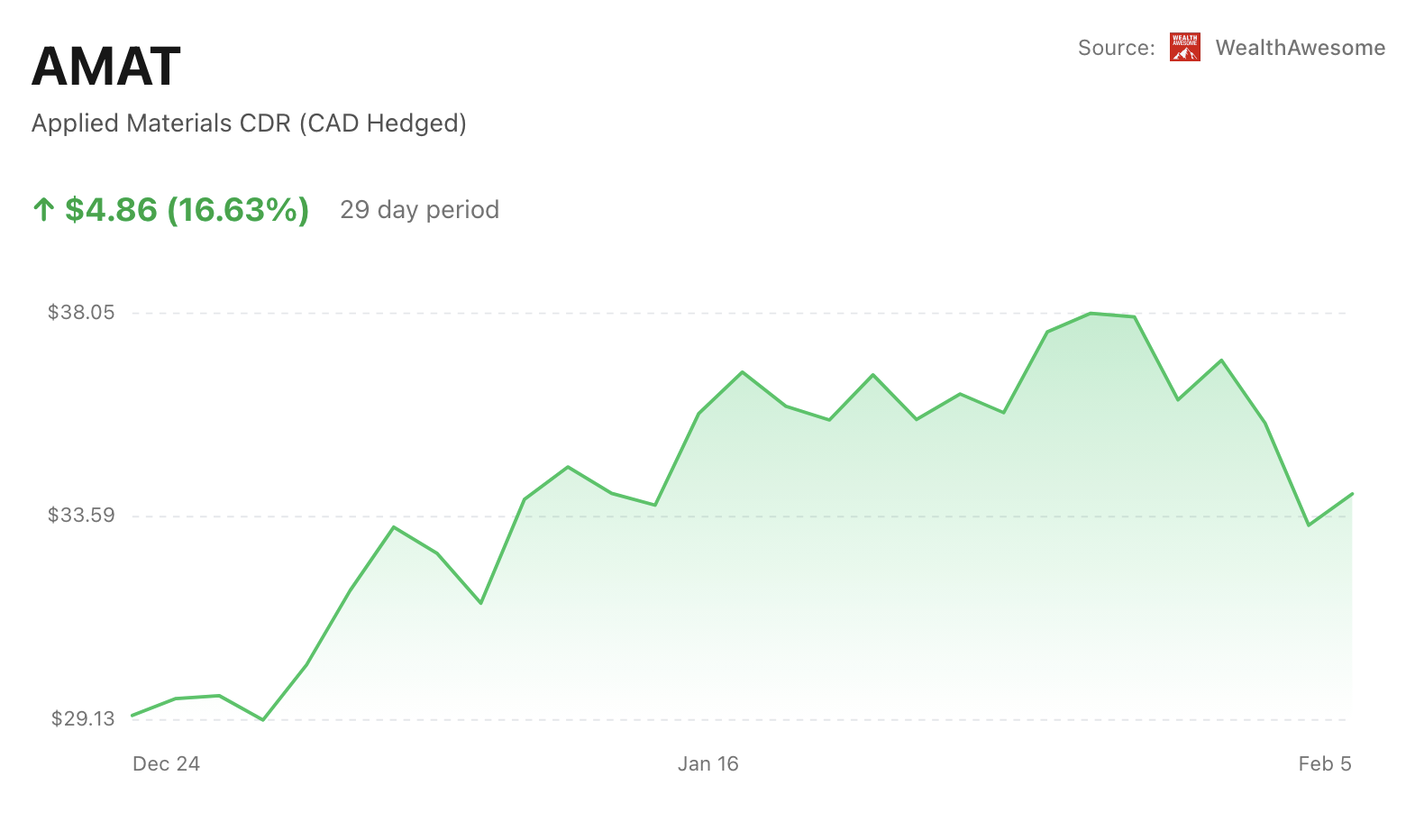
Applied Materials’ Canadian-listed CDR moved higher on Thursday, rebounding after a sharp pullback earlier in the week — even though no new company-specific headlines emerged.
The move stood out because it followed several days of selling across semiconductor stocks and came as broader North American markets stabilized. For Canadian investors holding the CAD-hedged version of the stock, the session highlighted how quickly price action can reset once downside pressure fades.
Advertisement
Applied Materials CDR (CAD Hedged)
AMAT.TO
AMAT.TO
Applied Materials CDR (CAD Hedged)
 WealthAwesome
Market cap
$314.06B
P/E
33.9x
Div. yield
4.33%
Div. / share
$1.98
52W high
$82.07
52W low
$23.32
1W change
-8.39%
Wealth Awesome Price Forecast
WA ModelStatistical 90-day price range based on AMAT's historical volatility
30-Day Vol
52.6%
Annualized
90-Day Vol
75.9%
Annualized
Trend (90d)
-50.0%
Annualized drift
90d Mean
C$37.79
Expected price
| Horizon | Expected | 68% Range (1σ) |
|---|---|---|
| 30 trading days | C$42.57 | C$35.50 – C$51.04 |
| 60 trading days | C$40.11 | C$31.03 – C$51.84 |
| 90 trading days | C$37.79 | C$27.60 – C$51.75 |
Methodology: Range is calculated using 30-day realized volatility via geometric Brownian motion (log-normal model). 68% band = ±1σ, 95% band = ±2σ. This is a statistical model, not a prediction. Past volatility does not guarantee future results. Not financial advice.
Advertisement
What Just Happened
- Applied Materials CDR (CAD Hedged) rose 2.07% on Thursday, closing at $34.09 on the Toronto Stock Exchange
- The stock rebounded after sliding from near $38 in late January
- Trading volumes were modest, pointing to a technical bounce rather than aggressive new buying
- There were no earnings releases, guidance updates, or corporate announcements during the session
Why the Market Cares
This move was about positioning, not news.
Applied Materials sits at the center of the global semiconductor equipment cycle, making its shares especially sensitive to changes in sentiment around chip demand, capital spending, and interest rates. After January’s strong rally, the sector had become vulnerable to profit-taking, and this week’s pullback reflected that pressure.
Thursday’s rebound suggests some of that selling ran its course. While the stock remains below its recent highs, the stabilization came alongside firmer broader markets — a signal that risk appetite improved enough to bring buyers back into large, liquid technology names.
The CDR structure also matters for Canadian investors. Because the instrument is CAD-hedged, currency moves play a limited role in day-to-day pricing. That makes rebounds more directly tied to the underlying U.S.-listed shares, which themselves found support as semiconductor peers steadied.
Sector dynamics reinforced the move. Semiconductor equipment stocks tend to trade in clusters, and when volatility cools, capital often rotates back into established leaders rather than smaller, higher-beta names. Applied Materials fits that profile.
The Key Number
Advertisement
+2.07%
That was the stock’s one-day gain, clawing back part of the ground lost earlier in the week after a double-digit slide from late-January levels.
What Happens Next
The focus now shifts to whether this rebound holds.
If equity markets remain stable, Applied Materials could continue to consolidate after last week’s selloff, reducing the risk of another sharp leg lower even without fresh catalysts. That would likely keep the stock range-bound near current levels.
If volatility returns — particularly around interest rates or semiconductor spending expectations — the bounce could fade just as quickly. The stock is still well below its recent highs, and sentiment across the sector remains sensitive.
The next meaningful catalyst remains earnings or updated industry spending signals. Until then, price action is likely to be driven by broader market tone rather than company-specific developments.
Bottom Line
Applied Materials’ move higher today wasn’t sparked by news — it was driven by market mechanics.
After a fast pullback, selling pressure eased and the stock found support as sentiment across equities improved. For Canadian investors watching the CDR, the session mattered because it showed how quickly semiconductor stocks can stabilize once fear subsides, even before fundamentals change.
Best next step
Keep exploring this topic
If you want to go deeper, these are the most useful follow-up pages and tools for this topic.
Broker comparison
Best trading platforms in Canada
Compare $0-commission brokers before you act on a ticker story.
Safe cash
Best GIC rates in Canada
If the story makes you want to de-risk, compare guaranteed rates next.
HISA roundup
Best high-interest savings accounts
Keep dry powder in a no-fee savings account instead of chequing.
TFSA room
Check TFSA contribution room
Shelter the next contribution before you buy.
Advertisement

Qayyum Rajan, CFA
Qayyum is the CEO of Wealth Awesome, a leading Canadian personal finance publication. As a CFA charterholder with extensive experience in fintech, data science, and quantitative finance, he brings a unique analytical perspective to investing and wealth management.
View Full Profile →✅ Reviewed by Certified Financial Professionals
This content has been reviewed by CFA® charterholders and Certified Financial Planners (CFP®) with over a decade of experience in Canadian financial markets. All information is fact-checked against official Canadian sources and regulations.
Why these credentials matter: CFA® charterholders complete 900+ hours of rigorous study in investment analysis and ethics. CFP® professionals are held to the highest standards of financial planning competency and fiduciary duty in Canada.
⚠️ Professional Disclaimer
This content is for educational purposes only and should not be considered personalized financial advice. While our team brings professional expertise, individual circumstances vary. For personalized guidance, consult with a qualified financial advisor, tax professional, or mortgage specialist.