By Darim Abdullah, CFA, MBA
Director, ETFs and Portfolio Consulting, BMO ETFs
June 2026
Looking for consistent cash flow without the guesswork? See how Target Cash Flow ETFs are redefining cash flow investing.
For many investors, especially those approaching or in retirement, generating consistent cash flow is one of the most important goals in a portfolio. Traditionally, that meant relying on dividends, coupons, or systematic withdrawals. But these sources can fluctuate, making it difficult to plan with confidence.
A newer category of solutions, Target Cash Flow ETFs, has been launched by BMO ETFs to help address this challenge. These strategies shift the focus from simply “earning yield” to delivering a defined cash flow outcome.
What Are Target Cash Flow ETFs?
Unlike traditional income funds, where payouts depend on underlying dividends or interest earned, Target Cash Flow ETFs take a more structured approach. They aim to deliver regular monthly distributions based on a predefined annual target — approximately 6%–15% depending on the ETF1 — rather than whatever cash flow the portfolio happens to generate.
This approach aligns with the broader rise of “outcome-oriented” investing, where ETFs are built to meet specific investor goals, such as generating cash flow or reducing volatility.
How Do They Work?
The key difference lies in how distributions are generated.
- Traditional cash flow ETFs generally pay out what the portfolio earns through dividends, interest, and option premiums.
- Target Cash Flow ETFs aim to pay out a set amount, regardless of market conditions.2
To deliver a more regular monthly cash flow, the distribution is built using a blended funding approach. Cash flow may come from the portfolio’s natural sources of return — dividends, interest, and, where applicable, option premiums — and may also include Return of Capital (ROC).
ROC doesn’t create an immediate tax liability, but it does reduce your Adjusted Cost Base (ACB) over time, which can affect taxes when the investment is sold. And if ROC isn’t offset by portfolio growth, it can gradually reduce invested capital.
That’s why it’s important to assess the strategy through a total return lens, not just the cash flow. If the portfolio’s total return stays above the distribution yield, the client’s underlying capital can still grow over time; if it’s persistently below the payout, the likelihood of capital erosion increases.
With the above payout breakdown in mind, it is worth noting that the payout levels for the T series solutions were carefully selected after examining the historical long-term returns of the parent portfolios, with the aim of minimizing the return of an investor’s initial capital as much as possible. Over the long term, the objective is for the distribution levels to be supported by the total returns of the underlying portfolios.
BMO’s Target Cash Flow Offering
BMO has been an early innovator in this space in Canada,3 introducing Target Cash Flow Units — often referred to as “.T series” — across a broad lineup of ETFs.
These units are available on a range of existing strategies, including:
- Asset allocation ETFs, such as all-equity or balanced portfolios
- Covered call ETFs, both dividend- and sector-focused
Rather than launching entirely new funds, BMO has added a new .T series of units to existing ETFs, giving investors the ability to choose between traditional distributions and a targeted cash flow approach within the same parent strategy.
Key Features
BMO’s Target Cash Flow Units are designed to offer:
- Monthly cash distributions for regular cash flow
- Target distribution ranges of approximately 6%–15%, depending on the ETF
- Flexibility to match cash flow needs with different strategies or blend multiple ETFs to customize the distribution rate
- A transparent structure, where the target payout is clearly defined
The Bottom Line
Target Cash Flow ETFs represent an evolution in cash flow investing — one that prioritizes regular cash flow and investor outcomes over traditional yield metrics.
BMO’s approach — offering Target Cash Flow Units across a wide range of ETFs — provides investors with a flexible and transparent way to generate regular monthly cash flow while remaining fully invested.
For those seeking a more structured approach to cash flow, especially in retirement or drawdown phases, these strategies can play a valuable role in building a portfolio designed not just to grow wealth, but to support how that wealth is used.
Performance Table
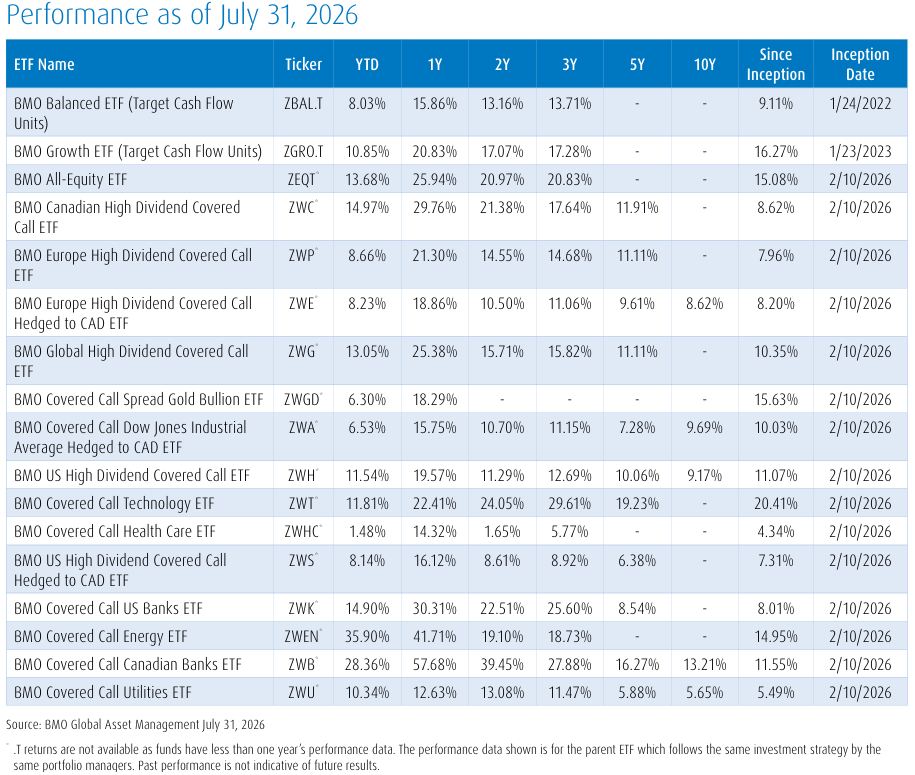
Source: BMO Global Asset Management, July 31, 2026. .T returns are not available as funds have less than one year’s performance data. The performance data shown is for the parent ETF, which follows the same investment strategy by the same portfolio managers. Past performance is not indicative of future results.
Notes
Disclaimer
This content is sponsored by BMO ETFs. This social media network is an independent organization and is not affiliated with BMO ETFs or BMO Global Asset Management.
This content is intended for information purposes only. Wealth Awesome is compensated under this arrangement by BMO ETFs.
The material is for information purposes. The information contained herein is not, and should not be construed as, investment, tax or legal advice to any party. Investments should be evaluated relative to the individual’s investment objectives and professional advice should be obtained with respect to any circumstance.
Any statement that necessarily depends on future events may be a forward-looking statement. Forward-looking statements are not guarantees of performance. They involve risks, uncertainties and assumptions. Although such statements are based on assumptions that are believed to be reasonable, there can be no assurance that actual results will not differ materially from expectations. Investors are cautioned not to rely unduly on any forward-looking statements. In connection with any forward-looking statements, investors should carefully consider the areas of risk described in the most recent prospectus.
The Dow Jones Industrial Average Index is a product of S&P Dow Jones Indices LLC or its affiliates (SPDJI), and has been licensed for use by BMO Asset Management Inc. S&P®, S&P 500®, US 500, The 500, iBoxx®, iTraxx® and CDX® are trademarks of S&P Global, Inc. or its affiliates (S&P) and Dow Jones® is a registered trademark of Dow Jones Trademark Holdings LLC (Dow Jones), and these trademarks have been licensed for use by SPDJI and sublicensed for certain purposes by BMO Asset Management Inc. The relevant BMO ETF is not sponsored, endorsed, sold or promoted by SPDJI, Dow Jones, S&P, their respective affiliates, and none of such parties make any representation regarding the advisability of investing in such product(s), nor do they have any liability for any errors, omissions, or interruptions of the Index.
The Target Cash Flow Units are subject to capital depletion risk. Target Cash Flow Units make monthly distributions of a fixed amount which may comprise, in whole or in part, a return of capital (“ROC”). A ROC reduces the amount of an original investment and may result in the return to investors of the entire amount of an original investment. A ROC that is not reinvested will reduce the NAV of the BMO ETF, which could reduce the BMO ETF’s ability to generate future income. Investors should not draw any conclusions about the BMO ETF’s investment performance from the amount of this distribution. A ROC can only be made by a series of a BMO ETF to the extent that there is a positive balance in the capital account for the relevant series. To the extent that the balance in the capital account becomes, or is at risk of becoming, zero, monthly distributions may be reduced or discontinued without prior notice.
The dollar amount of the monthly distribution that investors will receive is reset at the beginning of each calendar year. The dollar amount is a factor of the annualized distribution rate for the Target Cash Flow Units (which is the rate set out in the individual BMO ETF profiles in the simplified prospectus of the BMO ETFs), the NAVPS as of the end of the previous calendar year, and the number of Target Cash Flow Units of the BMO ETF held at the time of the distribution. Although not expected, we may also adjust the monthly distribution during the year, if capital market conditions have significantly affected the ability of the BMO ETF to maintain the applicable distribution. If we make any such adjustment to the monthly distribution, we will issue a press release to communicate the change. The distribution rate applicable to the Target Cash Flow Units may be higher than the rate of return or the portfolio yield of the BMO ETF that offers such Units. As a result, if investors elect to receive some or all of the regular monthly distributions in cash, the value of their investment in the BMO ETF may decline over time.
Distributions from Target Cash Flow Units will include a ROC. A ROC does not necessarily reflect the BMO ETF's investment performance and should not be confused with “yield” or “income”. Investors should not draw any conclusions about the BMO ETF's investment performance from the amount of these distributions. A ROC does not create an immediate tax liability, but it reduces investors' Adjusted Cost Base (“ACB”) over time; this may affect taxes when the investment is sold. Investors should consult a tax advisor.
Commissions, management fees and expenses all may be associated with investments in exchange-traded funds. Please read the ETF Facts or prospectus of the BMO ETFs before investing. The indicated rates of return are the historical annual compounded total returns including changes in unit value and reinvestment of all dividends or distributions and do not take into account sales, redemption, distribution or optional charges or income taxes payable by any unitholder that would have reduced returns. Exchange-traded funds are not guaranteed, their values change frequently and past performance may not be repeated.
For a summary of the risks of an investment in the BMO ETFs, please see the specific risks set out in the ETF facts or prospectus. BMO ETFs trade like stocks, fluctuate in market value and may trade at a discount to their net asset value, which may increase the risk of loss. Distributions are not guaranteed and are subject to change and/or elimination.
BMO ETFs are managed by BMO Asset Management Inc., an investment fund manager, a portfolio manager, and a separate legal entity from Bank of Montreal.
BMO Global Asset Management is a brand name under which BMO Asset Management Inc. and BMO Investments Inc. operate.
“BMO (M-bar roundel symbol)” is a registered trademark of Bank of Montreal, used under licence.
Footnotes
-
The Target Cash Flow Units' distribution rate is not guaranteed and is potentially subject to change. The target distribution rate is not an indicator of overall performance and the value of your investment in the BMO ETF may decline over time. ↩
-
The Target Cash Flow Units of certain BMO ETFs are designed to provide investors with a monthly distribution based on a target annual distribution rate which is based on the NAVPS at the end of the prior year, or in the case of a newly created series, based on a target annualized distribution rate which is based on the initial starting NAVPS. ↩
-
ZBAL.T, the BMO Balanced ETF (Target Cash Flow Units), was launched on January 24, 2022. ↩
Best next step
Keep exploring this topic
If you want to go deeper, these are the most useful follow-up pages and tools for this topic.
Gold ETFs
Best gold ETFs in Canada
Compare physically backed and miner gold ETFs, including CGL, VALT, KILO, and XGD.
ETF hub
Browse ETF categories by goal
Jump into core, dividend, fixed-income, and sector ETF clusters from one place.
ETF tool
Use the Canadian ETF screener
Filter ETFs by yield, AUM, and performance when you are narrowing a shortlist.
Popular guide
Start with our top ETF roundup
Start with a broad ETF guide if you want a quick shortlist across the main fund categories.
✅ Reviewed by Certified Financial Professionals
This content has been reviewed by CFA® charterholders and Certified Financial Planners (CFP®) with over a decade of experience in Canadian financial markets. All information is fact-checked against official Canadian sources and regulations.
Why these credentials matter: CFA® charterholders complete 900+ hours of rigorous study in investment analysis and ethics. CFP® professionals are held to the highest standards of financial planning competency and fiduciary duty in Canada.
⚠️ Professional Disclaimer
This content is for educational purposes only and should not be considered personalized financial advice. While our team brings professional expertise, individual circumstances vary. For personalized guidance, consult with a qualified financial advisor, tax professional, or mortgage specialist.