CIBC Investor's Edge
Transfer your investments to CIBC Investor's Edge and get rewarded with an offer of up to $3,000.
- ✓$6.95 flat-rate commissions
- ✓Backed by Big Five bank security
- ✓Transfer bonus offer up to $3,000
I’m a huge fan of Vanguard and its ETF selection for Canadians. The company is essentially a non-profit asset management firm since all of the profits are returned to investors in the form of lower fees.
I’m an even bigger fan of the relatively new Vanguard ETF Portfolio series. The portfolios are a shining example of investing that is made simple for all investors. It’s ideal for a TFSA or RRSP.
The Vanguard VGRO ETF is one of my favourite ones in this series. Let’s go over the reasons why:
[affiliatable id='26199']
Pros
- Easy to use and purchase
- Set it and forget it - no need to rebalance
- Provides worldwide diversification in one neat package
- Lower fees than robo-advisors and much lower than mutual funds
- Highly liquid
Cons
- Country asset allocation is slightly too heavily Canadian weighted
- Fees are slightly higher than some competitors
- Can lower your fees by buying individual ETFs
What is Vanguard VRGO ETF?
VRGO is a growth exchange-traded-fund (ETF) portfolio that has been trading on the Toronto Stock Exchange since January of 2018.
VGRO is an all-in-one ETF portfolio in Canada (a.k.a asset allocation ETF, or one-decision ETF) designed for simplicity and diversification at a low fee.
Currently, it’s trading at around $47.44.
VGRO Key Facts
As of Oct 11, 2023:
-
Ticker Symbol: VGRO.TO
-
Exchange: Toronto Stock Exchange
-
Assets Under Management: $4.10 Billion
-
MER: 0.24%
-
12-Month Trailing Yield: 2.20%
-
Currency Traded: CAD
-
Eligible Accounts: Most registered (TFSA, RRSP, etc.) and non-registered available
Vanguard All-In-One ETF Porfolios
One-ticket solutions are typically differentiated by their allocation to equities and to fixed income. Across most all-in-one solutions, the ETFs have different stock and bond weightings based on the fund’s advertised risk profile.
All-in-one ETFs have fairly generic names and usually look something like this (from low to high risk):
-
Very Conservative
-
Conservative
-
Balanced
-
Growth
-
Maximum Growth
A very conservative ETF will likely be close to 100% invested in fixed income. A maximum growth ETF will be closer to a 100% investment in stocks.
All-in-one ETFs rarely diversify outside of stocks and bonds into other investments, such as alternatives.
VGRO is the growth portfolio in this series and has a low-to-medium risk rating. You can learn more about the other Vanguard ETFs here.
| All-In-One ETF | Advertised Risk Rating | MER | Equity/Fixed Income % |
|---|---|---|---|
| VCIP | Low | 0.24% | 20/80 |
| VCNS | Low | 0.24% | 40/60 |
| VBAL | Low-to-Medium | 0.24% | 60/40 |
| VGRO | Low-to-Medium | 0.24% | 80/20 |
| VEQT | Medium | 0.24% | 100/0 |
| VRIF | Low-to-Medium | 0.32% | 35/65 |
VGRO MER
VGRO has a management fee of 0.22% and an MER of 0.24%. Even though this MER is higher than if you were to buy individual ETFs, I like it for several reasons:
-
The portfolio is automatically rebalanced, so you never have to worry about your asset mixes getting misaligned from what your original goals are.
-
The MER for VGRO is much lower than mutual funds.
-
The MER for VGRO is even lower than robo-advisors.
If convenience and simplicity are important to you, VGRO is a great choice.
VGRO Dividends
As of September 30, 2023:
-
12-month trailing yield: 2.20%
-
Distribution yield: 2.08%
-
Dividend schedule: Quarterly
VGRO Performance
There isn’t much data on VGRO since it just started in 2018. However, there shouldn’t be too many surprises with performance since the ETFs will perform its duties of mirroring the markets.
Here is the performance so far as of Oct 11, 2023. There are no surprises so far, given the underlying ETFs and the strong overall performances of the markets:

Go to the Vanguard website for updated performance numbers of VGRO.
What types of investments are inside VGRO?
Let's break down what you are investing in when you invest in VGRO:
VGRO Fund Holdings
VGRO consists of several different Vanguard ETFs. The asset mixes are designed to give you worldwide exposure, as you can see here.
It's heavily weighted toward Canada and the U.S., with some emerging markets and international stocks.
For VGRO’s asset allocation, around 80% is split between US and Canadian equities, with international equities and emerging markets taking up about 20%. The rest consists of bonds.
Here is the allocation as of Aug 31, 2023:
VGRO Stock and Bond Stats
Each of these ETFs contains hundreds or thousands of stocks. By investing in VGRO, you're investing in over 13,000 stocks from all around the world.
You're also investing in over 18,000 bonds. By simply clicking a button, you're getting access to over 31,000 different assets. That is a lot of diversification with one product.
As of Aug 31, 2023:
VGRO Asset Allocation
Currently, there are six different types of Vanguard portfolios, ranging in allocations from conservative to all equity.
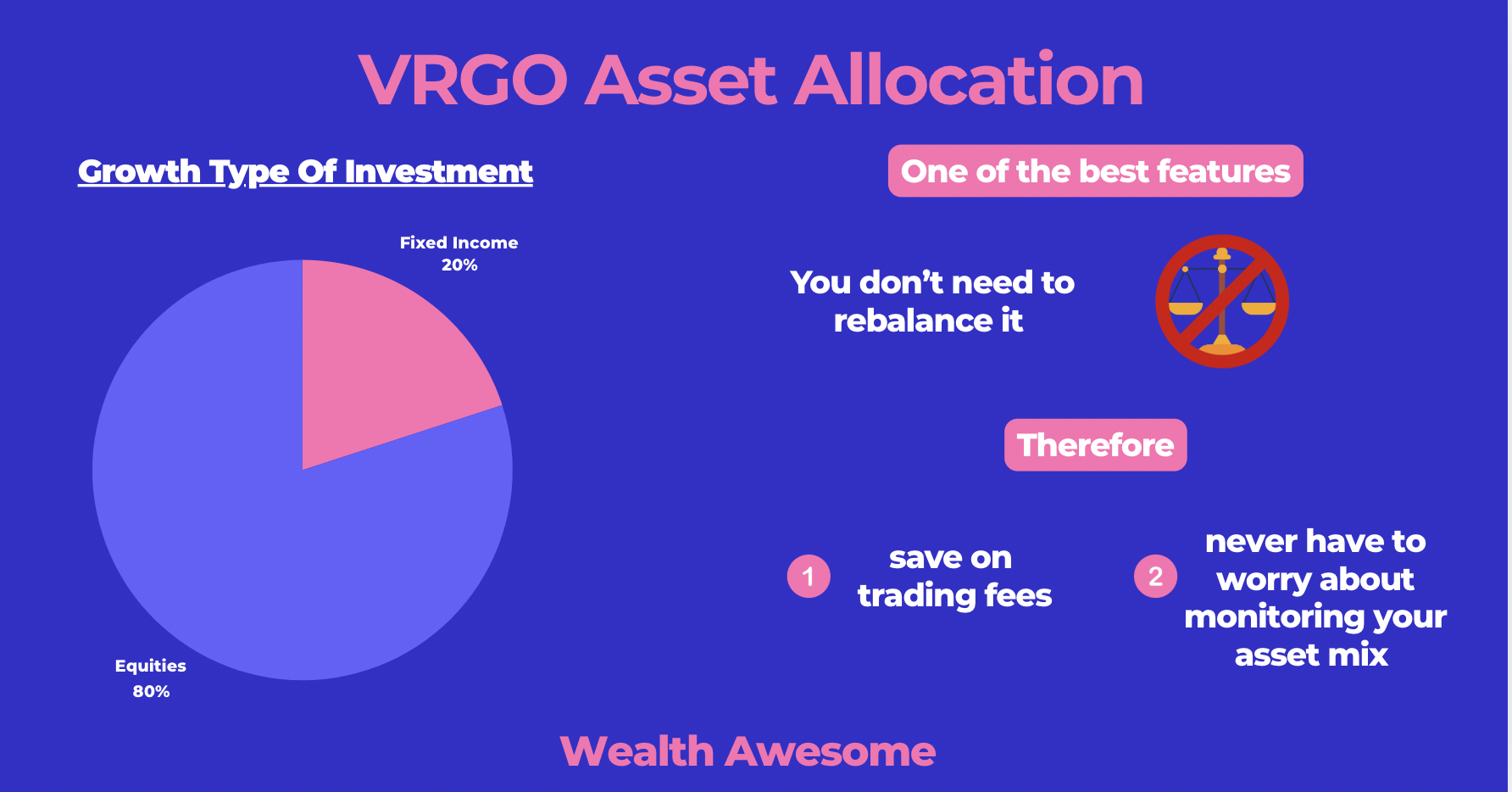
VGRO has an 80/20 split, making it 80% equities and 20% fixed income, which is why it is classified as a growth investment.
One of the best features of these portfolios is that you don’t need to rebalance it, as you would have to if you were to make the portfolio yourself.
Because of this feature, you will save on trading fees, plus you never have to worry about monitoring your asset mix.
What Companies are in VGRO?
The top ten holdings consist of top blue-chip stocks in Canada and the U.S., as you can see below. Because you are holding thousands of stocks, the top ten holdings don't actually hold that large of a total percentage of the overall portfolio.
You will always be diversified if you purchase VGRO, and you can rest assured that it holds many large companies that will be around for a while.
VGRO Holdings As of December 31, 2022:
| Holding Name | % of Market Value | Sector | Market Allocation |
|---|---|---|---|
| Apple Inc. | 2.24% | Computer Hardware | US |
| Microsoft Corp. | 1.94% | Software | US |
| Royal Bank of Canada | 1.41% | Banks | CA |
| Toronto-Dominion Bank | 1.25% | Banks | CA |
| Amazon.com Inc. | 0.96% | Diversified Retailers | US |
| NVIDIA Corp. | 0.93% | Semiconductors | US |
| Shopify Inc. | 0.86% | Consumer Digital Services | CA |
| Canadian Pacific Kansas City Ltd. | 0.83% | Railroads | CA |
| Enbridge Inc. | 0.8% | Pipelines | CA |
| Canadian Natural Resources Ltd. | 0.79% | Oil: Crude Producers | CA |
Risk Assessment of VGRO
The primary aim of VGRO is growth, and as such, it leans more towards equities. However, like all investments, VGRO comes with its set of risks and considerations.
-
Equity Exposure: VGRO has an 80/20 split between equities and fixed income. While this means there's a higher potential for growth, it also implies a higher degree of volatility compared to more conservative funds.
-
Geographical Considerations: VGRO has a significant exposure to Canadian and U.S. markets. While this might be seen as a benefit due to the stability of these economies, it also means the fund could be more sensitive to regional market downturns.
-
Credit Risk: On the bond side, VGRO mainly invests in bonds of investment grade. While this minimizes the chance of defaults, it's essential to be aware that no investment is entirely risk-free.
-
Long-term Perspective: Given its growth orientation, VGRO is best suited for investors with a long-term horizon who can ride out the market's short-term fluctuations.
VGRO Sector Weighting
VGRO has a nice sector mix of a lot of different industries. I like how it isn't overly weighted in tech and is broadly diversified. Industrials, consumer discretionary, and energy also hold a large sector weighting.
VGRO Sector Weighting As of Aug 31, 2023:
| Sector | Fund |
|---|---|
| Technology | 18.99% |
| Financials | 18.63% |
| Industrials | 13.03% |
| Consumer Discretionary | 12.07% |
| Energy | 8.5% |
| Health Care | 8.3% |
| Basic Materials | 6.16% |
| Consumer Staples | 4.94% |
| Utilities | 3.57% |
| Telecommunications | 3.03% |
| Real Estate | 2.78% |
| Other | 0.00% |
| Total | 100.00% |
VGRO Market Allocation
Most of the weighting is in the United States or Canada. These top 10 countries consist of 91% of the holdings, and the remainder is split up over many other countries.
| Country | Region | Fund |
|---|---|---|
| United States of America | North America | 44.6% |
| Canada | North America | 29.4% |
| Japan | Pacific | 4.6% |
| United Kingdom | Europe | 2.8% |
| China | Emerging Markets | 2.1% |
| France | Europe | 1.9% |
| Switzerland | Europe | 1.7% |
| Germany | Europe | 1.4% |
| Australia | Pacific | 1.4% |
| India | Emerging Markets | 1.2% |
| Total | 91.1% |
VGRO Bond Credit Quality
Let's not forget about the bonds. VGRO mostly buys bonds of investment grade (better than BBB- rating), so the chance of defaults is quite low.
As of Aug 31, 2023:
| Credit Rating | Fund |
|---|---|
| AAA | 32.8% |
| AA | 36.1% |
| A | 18.2% |
| BBB | 12.6% |
| Less than BBB | 0.0% |
| NR | 0.4% |
| Total | 100.0% |
Cons of VGRO
I personally feel there is too much Canadian exposure in VGRO. U.S. stocks tend to outperform Canadian stocks in the long run, so I would have liked to see an even higher weighting to the U.S.
You also don’t have control over what sectors or countries you would like to overweight.
Another slight disadvantage is that it is cheaper to build your own portfolio of ETFs than it is to buy an all-in-one ETF.
The MERs for VGRO are slightly higher than other competitors such as iShares (see a full overview here)
VGRO Alternatives
XGRO vs VGRO
iShares Core Growth ETF Portfolio, or XGRO, is a similar product that is offered by Blackrock. XGRO has a slightly lower MER than Vanguard's VGRO at 0.20% vs 0.24% and a similar asset mix split target of 80/20 for equities and bonds.
XGRO's U.S. and international weighting are slightly higher than VGRO and Canadian, and emerging markets are slightly less.
Overall, there isn’t much of a difference, and you can’t go wrong with either. However, until Vanguard lowers its fees to be the same as this iShares one, I think I would have to side with iShares. I like that it has a higher U.S. weighting also.
Here is the breakdown of XGRO assets as of October 10, 2023:
| Ticker | Name | Sector | Weight (%) |
|---|---|---|---|
| ITOT | ISHARES CORE S&P TOTAL U.S. STOCK | Corporates | 38.22 |
| XEF | ISHARES MSCI EAFE IMI INDEX | Corporates | 19.67 |
| XIC | ISHARES S&P/TSX CAPPED COMPOSITE | Corporates | 19.22 |
| XBB | ISHS CORE CAD UNIV BND IDX ETF (CA | Corporates | 11.80 |
| XEC | ISHARES MSCI EMERGING MARKET | Corporates | 4.00 |
| XSH | iShares Core CAD ST Cor Bd Index | Corporates | 3.05 |
| GOVT | ISHARES US TREASURY BOND ETF | Treasury | 1.85 |
| USIG | ISHARES BROAD USD INVESTMENT | Corporates | 1.85 |
| CAD | CAD CASH | Cash and/or Derivatives | 0.25 |
| USD | USD CASH | Cash and/or Derivatives | 0.10 |
VEQT vs VGRO
VEQT is Vanguard's all-equity all-one ETF portfolio. It is essentially the same as VGRO, except it has no bond holdings. Here are VEQTs holdings; as you can see there are only four ETFs and no bond ones:
As of 21 Aug 2023:
| Fund | |
|---|---|
| U.S. Total Market Index ETF | 35.77% |
| FTSE Canada All Cap Index ETF | 23.58% |
| FTSE Developed All Cap ex North America Index ETF | 15.52% |
| FTSE Canadian Aggregate Bond Index ETF | 11.60% |
| FTSE Emerging Markets All Cap Index ETF | 5.53% |
| Global ex-U.S. Aggregate Bond Index ETF (CAD-hedged) | 4.13% |
| U.S. Aggregate Bond Index ETF (CAD-hedged) | 3.87% |
You have a bit more flexibility with VEQT versus VGRO. For example, if you want a slightly more aggressive portfolio of 90% equity and 10% fixed income, you can achieve that with two ETFs.
Since there is no 90/10 Equity to Fixed income ETF that Vanguard offers, you can use 90% of your money to buy VEQT and the other 10% to buy a bond ETF.
Who should buy VGRO?
If you have a higher risk tolerance and have a TFSA or RRSP account that you want to set and forget, VGRO could be the perfect ETF for you.
You won’t have to worry about rebalancing the portfolio; contribute to it regularly and watch your assets grow.
I think it's a great choice for both beginner and experienced investors. I invest in VGRO for my smaller accounts, as it is much easier than building your own portfolio of ETFs.
How to buy vGRO ETF in Canada
FAQs
Is VGRO a good long-term investment option?
VGRO is primarily geared towards long-term growth, with an asset allocation leaning heavily towards equities. This kind of asset mix, featuring an 80/20 split between equities and fixed income, seeks to capitalize on the potential growth of the stock market over extended periods.
Historically, equities have tended to outperform other asset classes in the long run, albeit with higher volatility. Given its diversified exposure to various markets worldwide, VGRO can be considered a suitable option for investors aiming for long-term capital appreciation.
Is VGRO suitable for a beginner investor?
VGRO's allure for many beginner investors lies in its simplicity and all-in-one approach. Instead of constructing a diversified portfolio from scratch, VGRO offers an immediate solution with a blend of stocks and bonds.
The automatic rebalancing feature also takes away the need for regular manual adjustments, which can be daunting for those new to investing. While its equity-heavy composition might introduce more volatility than conservative portfolios, its diversified nature can help spread out risks.
For beginners who are looking to invest for the long-term and can tolerate some market fluctuations, VGRO can be an appropriate starting point.
Can VGRO be used as a retirement investment option?
VGRO can indeed be used as part of a retirement investment strategy. Its growth-oriented design can be especially beneficial for individuals who are still several years away from retirement and are looking for capital appreciation.
The automatic rebalancing ensures that the asset allocation remains consistent, which can be a boon for those who prefer a hands-off investment approach. However, as one nears retirement, it might be prudent to evaluate the risk profile of VGRO in the context of one's entire portfolio.
Conclusion
Vanguard’s VGRO is a great option for investors who want worldwide diversification and to have passive index investing without needing to monitor the account.
I like to think of investing as exercising. If the gym you go to is difficult to get to and out of the way, you are less likely to go to it. It's the same with investing; if it is too confusing or you need to monitor too much, many people won’t bother with investing or pay unreasonably high fees for an advisor to stick them into a mutual fund.
That’s why I think these new Vanguard portfolio series are so great: buy it and forget it, and watch your account grow over the years!
If you think you're ready to buy VGRO, learn about how to buy ETFs in Canada.
Best next step
Keep exploring this topic
If you want to go deeper, these are the most useful follow-up pages and tools for this topic.
ETF hub
Browse ETF categories by goal
Jump into core, dividend, fixed-income, and sector ETF clusters from one place.
ETF tool
Use the Canadian ETF screener
Filter ETFs by yield, AUM, and performance when you are narrowing a shortlist.
Popular guide
Start with our top ETF roundup
Start with a broad ETF guide if you want a quick shortlist across the main fund categories.
Advertisement
7 stocks to buy and hold forever
Proven winners for income investors — blue-chip dividend stocks to hold for decades.
Get the FREE Report
Christopher Liew, CFA, CFP®
Christopher is the founder of Blueprint Financial and a CTV News personal finance columnist. As a dual-designated CFA charterholder and Certified Financial Planner (CFP®), he helps Canadians reduce financial stress through clear, customized financial plans.
View Full Profile →✅ Reviewed by Certified Financial Professionals
This content has been reviewed by CFA® charterholders and Certified Financial Planners (CFP®) with over a decade of experience in Canadian financial markets. All information is fact-checked against official Canadian sources and regulations.
Why these credentials matter: CFA® charterholders complete 900+ hours of rigorous study in investment analysis and ethics. CFP® professionals are held to the highest standards of financial planning competency and fiduciary duty in Canada.
⚠️ Professional Disclaimer
This content is for educational purposes only and should not be considered personalized financial advice. While our team brings professional expertise, individual circumstances vary. For personalized guidance, consult with a qualified financial advisor, tax professional, or mortgage specialist.