Investing in health care in Canada is a bit of a tricky task due to our public health care system.
Luckily, we have ETFs we can invest in to get access to global healthcare companies.
This iShares XHC ETF review will discuss a fund that can give you exposure to t a globally diversified healthcare index.
Advertisement
[affiliatable id='82043']
Pros
- Targeted exposure to equities of issuers in the global healthcare sector
- Can be used to gain access to a global sector
- Low-cost exposure to a wide group of healthcare stocks
Cons
- MER is quite high
What Is IShares XHC ETF?
iShares Global Healthcare Index ETF (CAD-Hedged) (HXC) is a low-cost ETF that offers you exposure to a group of equity securities in the healthcare sector of the global economy.
The fund began trading on the TSX on April 12, 2011, and boasts an extensive performance history.
iShares XHC ETF is designed as a long-term holding that delivers wealth growth through capital gains. It also offers semi-annual cash distributions.
XHC.TO is currently trading at close to $79.43.
XHC Key Facts
As of June 30, 2022:
- Ticker Symbol: XHC.TO
- Exchange: Toronto Stock Exchange
- Assets Under Management: $536 Million
- MER: 0.65%
- 12-Month Trailing Yield: 0.88%
- Currency Traded: CAD
- Number of Underlying Holdings: 116
- Eligible Accounts: Most registered (TFSA, RRSP, etc) and non-registered available
IShares XHC MER And Fees
XHC ETF relies on currency hedging, which comes at a cost. It boasts a management fee of 0.63% and a Management Expense Ratio (MER) of 0.65%.
IShares XHC Dividends
iShares XHC's dividend yield as of July 26, 2022:
- 12-month trailing yield: 0.86%
- Distribution yield: 0.90%
- Dividend schedule: Semi-Annual
IShares XHC Performance And Returns
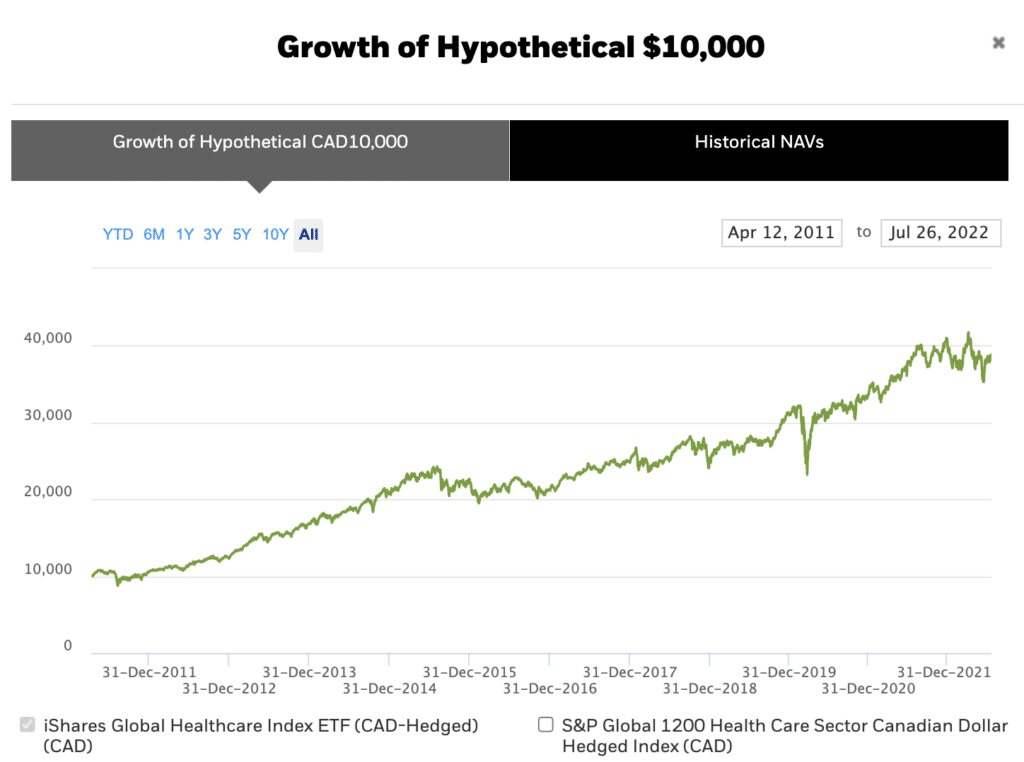
Here's the growth of a hypothetical $10,000 invested in iShares XHC since inception:
What Does the IShares XHC ETF Invest In?
iShares XHC ETF is an all-equity ETF because the fund invests the entirety of its assets under management to a globally diversified portfolio of stocks.
The fund can be used to reflect a global sector view of the healthcare industry because it focuses on publicly-traded healthcare companies.
iShares XHC ETF does not directly invest in its underlying holdings. Rather, it allocates its funds to the iShares IXJ ETF, an exchange-traded fund listed on the NYSE Arca Stock Exchange.
iShares XHC ETF uses a currency hedging strategy to provide you with investment returns in Canadian dollars. The strategy mitigates the risk that comes with currency fluctuation.
IShares XHC ETF Top Holdings
iShares XHC invests in a globally diversified portfolio of healthcare companies. The fund does not directly invest in the different publicly-traded companies in its holdings.
iShares Global Healthcare ETF Trust (IXJ) is its primary holding, accounting for the entirety of its asset allocation, the returns for which are hedged back to the Canadian dollar.
As of July 27, 2022, iShares XHC ETF’s top holding is the US-listed iShares Global Healthcare ETF Trust:
IShares XHC ETF Aggregate Underlying Holdings
iShares XHC ETF’s top three holdings comprise UnitedHealth Group Inc., which accounts for 7.21% of its asset allocation. Johnson & Johnson is its second-largest holding, accounting for 6.55% of its asset allocation.
Pfizer Inc. is its third-largest holding, accounting for 4.19% of its asset allocation. The fund’s top ten holdings account for 41.26% of its entire asset allocation.
What Is The Health Care Index? IShares XHC ETF Geographical Breakdown
The S&P Global 1200 Healthcare Sector Index, or the Health Care Index, is the benchmark index used by iShares IXJ ETF to determine its underlying holdings.
The index comprises the equity securities of various globally diversified equity securities of issuers in the healthcare sector worldwide.
The geographical breakdown of its asset allocation below shows where its constituent securities are listed.
As of July 26, 2022, equity securities listed in the United States account for the bulk of its asset allocation, with a 71.17% asset allocation.
Switzerland-listed stocks account for 8.40% of its asset allocation, followed by Japan-listed equity securities, accounting for 4.47% of its asset allocation.
iShares XHC ETF Sector Weighting
As of July 26, 2022, its most significant asset allocation is towards the Pharma, Biotech & Life Sciences sectors at 64.86%. Its second most significant sector exposure is towards Health Care Equipment & Services at 34.22%.
iShares XHC Risk Indicator
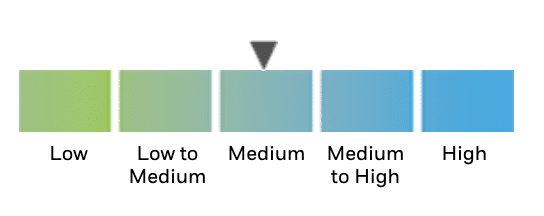
iShares XHC has a medium risk factor.
What Is the IShares Global Healthcare ETF?
iShares Global Healthcare ETF is a fund listed on the NYSE Arca Stock Exchange, and it is the primary holding for iShares XHC ETF.
iShares IXJ tracks the performance of the S&P Global 1200 Healthcare Sector Index, before fees and expenses.
The underlying index for the fund is designed to measure the performance of global healthcare, medical equipment, biotechnology, and pharmaceutical companies, including large-, mid-, and small-cap stocks.
iShares XHC provides you with investment returns through iShares IXJ.
IShares XHC ETF Alternatives
IShares XHC ETF Vs. IShares IXJ ETF
iShares IXJ ETF is essentially a mirror of iShares XHC because both funds invest in the same equity securities. IXJ ETF is the primary holding for XHC ETF, and it does not use currency hedging strategies to provide you with investment returns.
The fund comes with an expense ratio of 0.43%, which is much lower than 0.65% for iShares XHC ETF.
iShares IXJ ETF could be a viable alternative to iShares XHC ETF if you want to invest in the performance of the global healthcare sector without currency hedging.
Since it is a US ETF though, you could look into something like Norbert's Gambit to mitigate some of the foreign exchange fees you'll have to pay.
IShares XHC ETF Vs. IShares XUT ETF
iShares XUT ETF is another fund that seeks to provide you with long-term capital growth by tracking the performance of an all-equity index.
However, the fund tracks the performance of the Canadian utility sector by tracking the performance of the S&P/TSX Capped Utilities Index. You can use the fund to invest in the Canadian utility industry.
It comes with an expense ratio of 0.61% and provides you with monthly cash distributions.
It could be a viable alternative to iShares XHC ETF if you would prefer reliable monthly cash distributions in a lower-risk asset class.
IShares XHC ETF Vs. TDOC ETF
TD Global Healthcare Leaders Index ETF is another fund designed to provide you with investment returns based on the performance of the global healthcare industry.
The fund tracks the performance of the Solactive Global Healthcare Leaders Index.
The fund’s underlying index focuses primarily on large- and mid-capitalization publicly-traded healthcare companies worldwide.
It shares a few commonalities with iShares XHC in its top holdings, but the two funds do not allocate funds to these securities with the same weighting.
TDOC ETF comes with a 0.35% expense ratio, which is significantly lower than iShares XHC ETF. It could be a viable alternative for you to consider.
How To Buy IShares XHC ETF In Canada
Conclusion
iShares Global Healthcare Index ETF (CAD-Hedged) offers you one of the best ways to express a global sector view in a single investment.
iShares XHC ETF could be a viable investment if you want a hands-off solution for reliable long-term investment returns through capital gains.
Remember that you might not get much in terms of cash distributions.
If you want to invest in ETFs that deliver monthly cash distributions, you should check out my breakdown of the best monthly dividend ETFs in Canada.
Best next step
Keep exploring this topic
If you want to go deeper, these are the most useful follow-up pages and tools for this topic.
Gold ETFs
Best gold ETFs in Canada
Compare physically backed and miner gold ETFs, including CGL, VALT, KILO, and XGD.
ETF hub
Browse ETF categories by goal
Jump into core, dividend, fixed-income, and sector ETF clusters from one place.
ETF tool
Use the Canadian ETF screener
Filter ETFs by yield, AUM, and performance when you are narrowing a shortlist.
Popular guide
Start with our top ETF roundup
Start with a broad ETF guide if you want a quick shortlist across the main fund categories.
Advertisement
7 stocks to buy and hold forever
Proven winners for income investors — blue-chip dividend stocks to hold for decades.
Get the FREE Report
Christopher Liew, CFA, CFP®
Christopher is the founder of Blueprint Financial and a CTV News personal finance columnist. As a dual-designated CFA charterholder and Certified Financial Planner (CFP®), he helps Canadians reduce financial stress through clear, customized financial plans.
View Full Profile →✅ Reviewed by Certified Financial Professionals
This content has been reviewed by CFA® charterholders and Certified Financial Planners (CFP®) with over a decade of experience in Canadian financial markets. All information is fact-checked against official Canadian sources and regulations.
Why these credentials matter: CFA® charterholders complete 900+ hours of rigorous study in investment analysis and ethics. CFP® professionals are held to the highest standards of financial planning competency and fiduciary duty in Canada.
⚠️ Professional Disclaimer
This content is for educational purposes only and should not be considered personalized financial advice. While our team brings professional expertise, individual circumstances vary. For personalized guidance, consult with a qualified financial advisor, tax professional, or mortgage specialist.